
Circular Economics: Rethinking the Linear Economy
For more than two centuries, industrial economies have largely followed a linear model of production: extract, manufacture, consume and dispose. While this approach has delivered significant economic growth, it has also accelerated resource depletion, environmental degradation and waste generation.
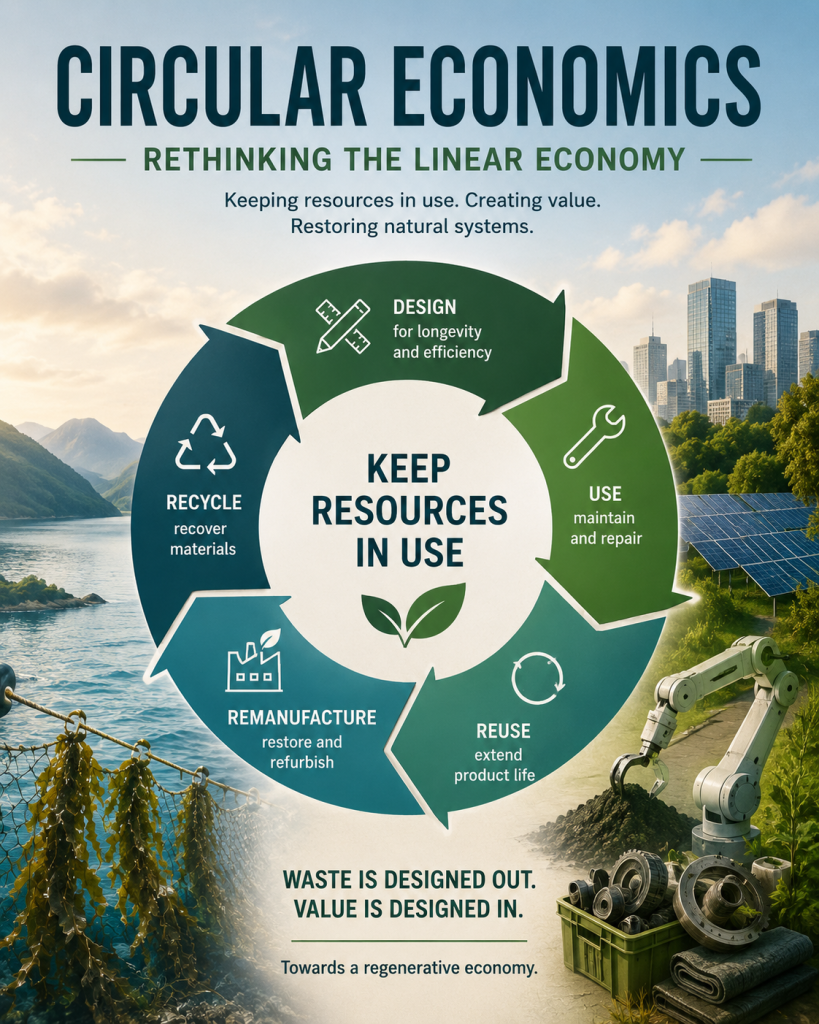
The concept of circular economics offers an alternative. Rather than treating products and materials as disposable, a circular economy seeks to keep resources in use for as long as possible through repair, reuse, remanufacture and recycling. In this way, economic value is preserved while reducing pressure on finite natural resources.
Among the earliest and most influential advocates of this approach is Walter R. Stahel. In The Circular Economy: A User’s Guide (2019), Stahel argues that extending the life of products and materials creates not only environmental benefits but also economic opportunities through innovation, skilled employment and improved resource productivity.
Circular economics is therefore not simply about recycling. It is about redesigning economic systems so that waste is minimised, resources retain their value, and growth becomes increasingly decoupled from resource extraction.
References
Stahel, W. R. (2019) The Circular Economy: A User’s Guide. Abingdon: Routledge.
Stahel, W. R. (1982) The Product-Life Factor. Geneva: Product-Life Institute.