
Powering the Future of Aquaculture with Renewable Energy
Modern aquaculture is often presented as one of the most sustainable methods of food production. Yet behind every fish farm, shellfish line, or seaweed cultivation system lies an often-overlooked challenge: energy.
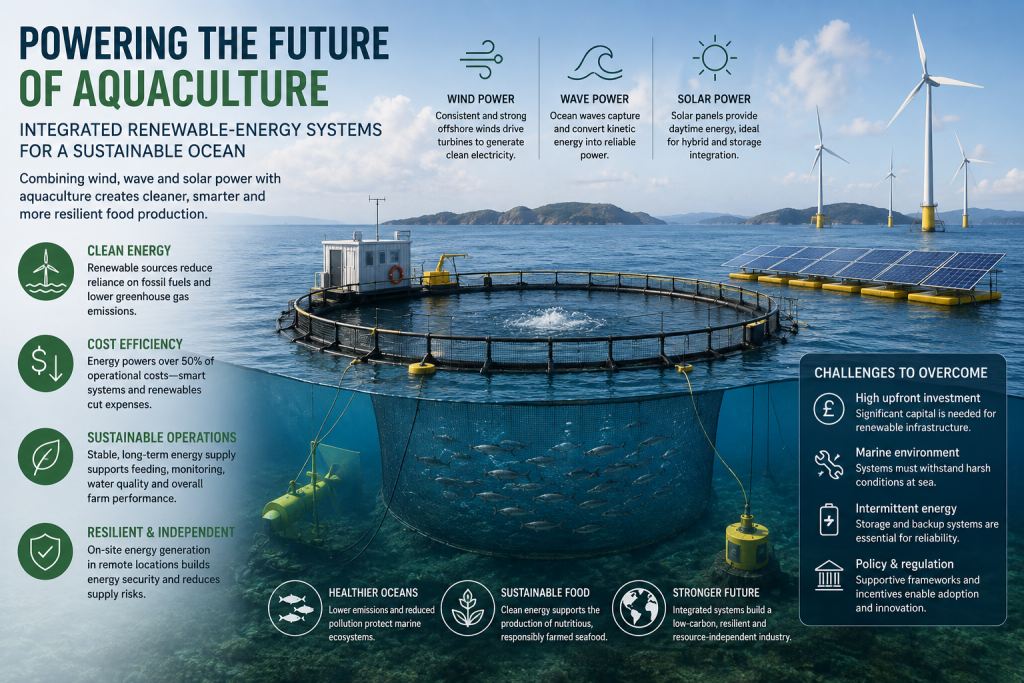
From automated feeding systems and water circulation to monitoring equipment and harvesting operations, aquaculture relies heavily on electricity and fuel. In many offshore or remote locations, this energy is still generated using diesel-powered generators, increasing both operating costs and greenhouse gas emissions. Integrating renewable energy into aquaculture offers a practical solution that improves environmental performance while strengthening the industry’s long-term economic resilience.¹
The Rise of Energy-Independent Aquaculture
Recent research has demonstrated that offshore aquaculture can be powered by combinations of wind, wave and solar energy. Rather than relying on fuel deliveries, offshore farms can generate much of their own electricity using the natural resources already available at sea. This reduces carbon emissions, lowers operating costs over time, and improves energy security for farms operating in isolated locations.¹
The concept extends beyond simply replacing diesel generators. Offshore Renewable Energy (ORE) systems have the potential to create largely energy-independent aquaculture facilities capable of supporting feeding systems, monitoring equipment, communications, refrigeration, and even autonomous vessels. As renewable technologies continue to improve, the distinction between an offshore wind farm and an offshore food production facility may become increasingly blurred.
Lower Costs Through Smarter Energy
Energy is only one component of operational expenditure, but it influences many others. Feed alone typically accounts for more than half of total production costs, making efficient feed management one of the most important factors affecting profitability. Renewable-powered automated feeding systems allow producers to optimise feeding schedules while reducing fuel consumption and labour requirements.²
Hybrid renewable energy systems—combining wind, wave and solar generation—have already been investigated along the Irish Atlantic coast, demonstrating that multiple renewable sources can work together to provide reliable electricity for offshore aquaculture operations.¹
Engineering Challenges at Sea
The transition to renewable energy is not without difficulties.
Marine environments are among the harshest operating conditions on Earth. Saltwater corrosion, high winds, powerful waves and storm events place significant demands on engineering design. Renewable infrastructure must therefore be built to withstand decades of exposure while remaining economically viable.³
Renewable energy also presents the familiar challenge of intermittency. Wind does not always blow, waves vary in intensity, and solar panels generate no electricity overnight. Successful offshore aquaculture therefore depends upon energy storage technologies and intelligent power management systems capable of maintaining continuous operations regardless of weather conditions.⁴
Perhaps the greatest barrier remains financial. Although renewable technologies reduce operating costs over their lifetime, the initial investment required for wind turbines, solar panels, battery storage and associated infrastructure can be substantial. For many small and medium-sized aquaculture businesses, these upfront costs remain the greatest obstacle to adoption.⁵
More Than Sustainability
Renewable energy offers aquaculture benefits that extend beyond reducing emissions.
Energy-independent farms are less vulnerable to volatile fuel prices, supply chain disruption, and geopolitical instability. For offshore operations located many miles from shore, generating electricity on-site also reduces the logistical complexity of transporting fuel, lowering operational risk while improving long-term resilience.
This aligns closely with the principles of resource sovereignty. Rather than depending upon imported fossil fuels, aquaculture businesses can harness naturally occurring local resources to produce both food and energy. In doing so, renewable-powered aquaculture becomes more than an environmental initiative—it becomes an investment in economic resilience, national food security, and a genuinely circular blue economy.
As offshore renewable energy and marine aquaculture continue to develop together, the future may not lie in separate industries, but in integrated marine systems that simultaneously generate clean electricity, produce sustainable food, and restore ocean ecosystems.
References
- M. O’Shea, Optimising the Renewable Power Generation Potential of a Novel Offshore Aquaculture System (2023); A. G. Charalambides, X. A. Kiparissides and P. Gikas, ‘Hydrogen Production and Utilization in Offshore Aquaculture: An Environmental and Economic Assessment’, Journal of Cleaner Production, 412 (2024), 132714.
- V. Vassiliou et al., ‘Aquaculture Feed Management System Powered by Renewable Energy Sources: Investment Justification’, Aquaculture Economics & Management, 19.4 (2015), pp. 423–443.
- F. Taveira-Pinto, P. Rosa-Santos and T. Fazeres-Ferradosa, ‘Marine Renewable Energy’, Renewable Energy (2020).
- E. T. Sayed et al., Renewable Energy and Energy Storage Systems (2023).
- J. P. Painuly, ‘Barriers to Renewable Energy Penetration: A Framework for Analysis’, Renewable Energy, 24.1 (2001), pp. 73–89.
Bibliography
Charalambides, A. G., Kiparissides, X. A. and Gikas, P., ‘Hydrogen Production and Utilization in Offshore Aquaculture: An Environmental and Economic Assessment’, Journal of Cleaner Production, 412 (2024), 132714.
O’Shea, M., Optimising the Renewable Power Generation Potential of a Novel Offshore Aquaculture System (2023).
Painuly, J. P., ‘Barriers to Renewable Energy Penetration: A Framework for Analysis’, Renewable Energy, 24.1 (2001), pp. 73–89.
Sayed, E. T., Olabi, A. G., Alami, A. H., Radwan, A., Mdallal, A., Rezk, A. and Abdelkareem, M. A., Renewable Energy and Energy Storage Systems (2023).
Taveira-Pinto, F., Rosa-Santos, P. and Fazeres-Ferradosa, T., ‘Marine Renewable Energy’ (2020).
Vassiliou, V., Charalambides, M., Menicou, M., Chartosia, N., Tzen, E., Evagelos, B., Papadopoulos, P. and Loucaides, A., ‘Aquaculture Feed Management System Powered by Renewable Energy Sources: Investment Justification’, Aquaculture Economics & Management, 19.4 (2015), pp. 423–443.