
The Blue Economy Explained: Can Economic Growth and Ocean Conservation Coexist?
For centuries, the ocean has been treated as a vast economic frontier — a source of food, transport routes, energy, and raw materials. Today, however, mounting evidence of overfishing, habitat destruction, pollution, and climate change has made it clear that marine resources are not limitless.1 In response, policymakers, scientists, and businesses have increasingly adopted the concept of the Blue Economy: an approach that seeks to generate economic growth from the ocean while preserving the ecosystems that make that growth possible. 2
The Ocean’s Economic Importance
The economic stakes are enormous. The World Bank estimates that ocean-related industries contribute roughly US$2.5 trillion annually to the global economy, making the ocean economy one of the world’s largest economic sectors. 3 Maritime transport alone carries around 80% of global merchandise trade by volume, underscoring how dependent modern commerce is on healthy and functioning seas. 4
Millions of livelihoods are tied directly to marine resources. Fisheries and aquaculture provide employment and income for coastal communities across the world, while aquatic foods supply essential nutrition for more than three billion people.5 Tourism, renewable energy, biotechnology, and coastal infrastructure add further layers to this economic system.
Why Sustainability Became Necessary
The traditional model of marine exploitation has proved increasingly unsustainable. The Food and Agriculture Organization reports that roughly one-third of assessed global fish stocks are overexploited, while many others are harvested at the edge of biological sustainability. 6 Plastic pollution, coastal degradation, and warming oceans are placing additional pressure on marine ecosystems. 7
These environmental problems are not only ecological concerns; they are economic risks. Declining fish stocks reduce future harvests, damaged reefs weaken tourism revenue, and climate-related ocean changes threaten coastal infrastructure and supply chains. 8 The Blue Economy emerged from the recognition that long-term profitability depends on maintaining the ocean’s natural capital.
What the Blue Economy Includes
The Blue Economy is broader than fisheries or conservation alone. It encompasses traditional maritime sectors such as shipping, ports, and seafood production but also newer industries including offshore wind power, marine biotechnology, carbon sequestration through mangroves and seagrasses, and sustainable aquaculture. 9
A central idea is that economic activity should operate within ecological limits. Rather than maximising short-term extraction, Blue Economy policies aim to create value while preserving ecosystem resilience. The OECD has argued that future ocean-based growth will depend heavily on improved governance, innovation, and environmental management. 10
Can Profit and Sustainability Align?
The relationship between profit and environmental protection is often framed as a trade-off, but evidence suggests the two can reinforce each other when incentives are structured correctly.
- Sustainable fisheries: Well-managed fisheries can rebuild stocks and improve long-term yields. Certification systems and science-based quotas have helped some fisheries recover while maintaining commercial viability.11
- Offshore renewable energy: Offshore wind has become one of the fastest-growing renewable energy sectors globally, providing low-carbon electricity and attracting major investment.12 Because turbines are located at sea, they avoid some of the land-use conflicts associated with terrestrial energy projects.
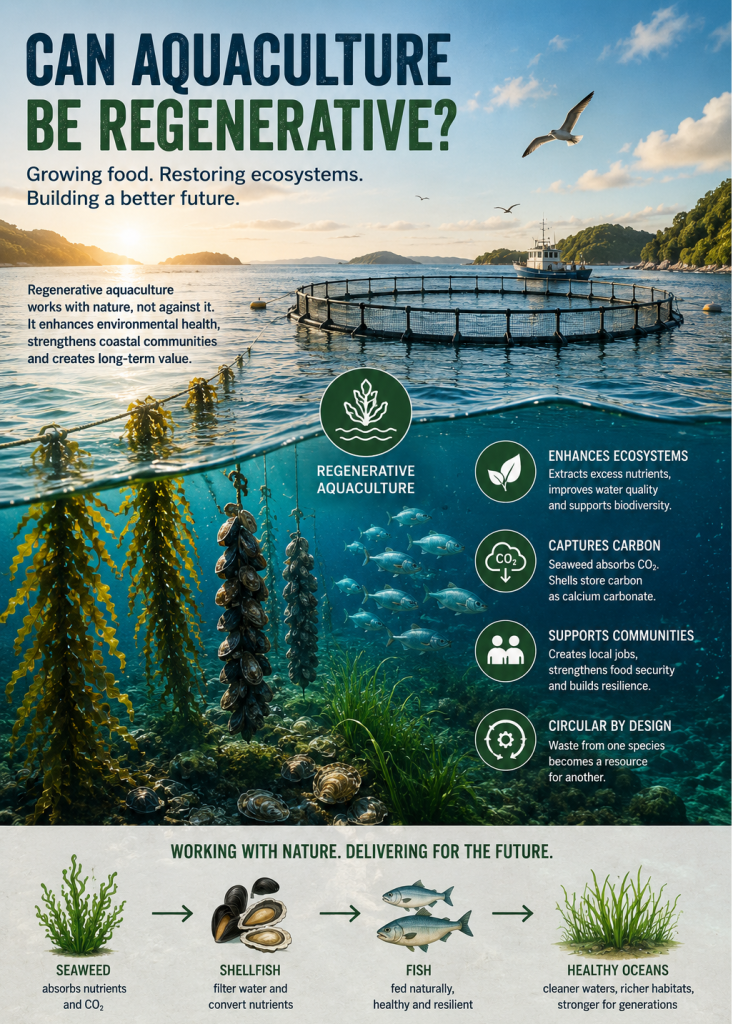
- Sustainable aquaculture: Aquaculture already supplies more than half of the fish consumed globally.13 Innovations such as integrated multi-trophic aquaculture and improved feed efficiency aim to reduce pollution and pressure on wild fish stocks while keeping production profitable.
- Nature-based coastal protection: Mangroves, salt marshes, and seagrasses store carbon and reduce coastal erosion. Protecting and restoring these ecosystems can deliver economic benefits by lowering disaster risk and supporting fisheries and tourism.14
The Obstacles Remain Serious
Despite these successes, major barriers remain.
Weak governance is a persistent problem. Much of the ocean lies beyond national jurisdiction, and enforcement against illegal fishing and pollution is uneven. 15 Short political cycles can also encourage governments to prioritise immediate economic gains over long-term ecosystem health.
There is also a danger of “blue washing” — companies or governments branding projects as sustainable without delivering meaningful environmental benefits. Without transparent standards, independent monitoring, and credible data, sustainability claims can become marketing tools rather than evidence-based practices. 16
Another challenge is equity. Large-scale ocean industries can generate significant profits, but benefits are not always shared fairly with coastal communities, Indigenous groups, or small-scale fishers who depend most directly on marine ecosystems. 17
The Bottom Line
The question is not whether the ocean can generate profit — it already does on a massive scale. The real question is whether economic systems can be redesigned so that profitability depends on maintaining healthy marine ecosystems rather than depleting them.
The evidence suggests coexistence is possible, but not automatic. Sustainable fisheries, offshore renewables, and ecosystem restoration projects show that environmental stewardship can support long-term economic returns. Yet these successes rely on strong governance, scientific monitoring, transparent standards, and incentives that reward sustainability instead of short-term extraction.
In that sense, the Blue Economy is less a guarantee than a test. It asks whether societies are willing to treat the ocean not as an inexhaustible mine, but as productive natural capital that must be maintained if future prosperity is to continue.
Footnotes:
- IPCC, Special Report on the Ocean and Cryosphere in a Changing Climate (Geneva: Intergovernmental Panel on Climate Change, 2019).
- United Nations Environment Programme, Sustainable Blue Economy (Nairobi: UNEP, 2023), available at: https://www.unep.org/topics/ocean-seas-and-coasts/ecosystem-based-approaches/sustainable-blue-economy (accessed 6 June 2026).
- World Bank, The Potential of the Blue Economy: Increasing Long-term Benefits of the Sustainable Use of Marine Resources for Small Island Developing States and Coastal Least Developed Countries (Washington, DC: World Bank, 2017).
- UNCTAD, Review of Maritime Transport 2024 (Geneva: United Nations Conference on Trade and Development, 2024), available at: https://unctad.org/publication/review-maritime-transport-2024 (accessed 6 June 2026).
- World Bank, Oceans, Fisheries and Coastal Economies (Washington, DC: World Bank, 2025), available at: https://www.worldbank.org/en/topic/oceans-fisheries-and-coastal-economies (accessed 6 June 2026).
- FAO, The State of World Fisheries and Aquaculture 2024 (Rome: Food and Agriculture Organization, 2024).
- UNEP, From Pollution to Solution: A Global Assessment of Marine Litter and Plastic Pollution (Nairobi: UNEP, 2021).
- IPCC, Special Report on the Ocean and Cryosphere in a Changing Climate.
- OECD, The Ocean Economy in 2030 (Paris: Organisation for Economic Co-operation and Development, 2016).
- OECD, The Ocean Economy in 2030 (Paris: OECD, 2016).
- Marine Stewardship Council, Annual Report 2024 (London: MSC, 2024).
- Global Wind Energy Council, Global Offshore Wind Report 2024 (Brussels: GWEC, 2024).
- FAO, The State of World Fisheries and Aquaculture 2024.
- UNEP, Out of the Blue: The Value of Seagrasses to the Environment and to People (Nairobi: UNEP, 2020).
- UN Convention on the Law of the Sea (UNCLOS), 1982.
- OECD, The Ocean Economy in 2030.
- World Bank, The Potential of the Blue Economy.
Bibliography
- FAO, The State of World Fisheries and Aquaculture 2024 (Rome: Food and Agriculture Organization, 2024).
- Global Wind Energy Council, Global Offshore Wind Report 2024 (Brussels: GWEC, 2024).
- IPCC, Special Report on the Ocean and Cryosphere in a Changing Climate (Geneva: Intergovernmental Panel on Climate Change, 2019).
- Marine Stewardship Council, Annual Report 2024 (London: MSC, 2024).
- OECD, The Ocean Economy in 2030 (Paris: Organisation for Economic Co-operation and Development, 2016).
- UNCTAD, Review of Maritime Transport 2024 (Geneva: United Nations Conference on Trade and Development, 2024).
- UNEP, From Pollution to Solution: A Global Assessment of Marine Litter and Plastic Pollution (Nairobi: UNEP, 2021).
- UNEP, Out of the Blue: The Value of Seagrasses to the Environment and to People (Nairobi: UNEP, 2020).
- UNEP, Sustainable Blue Economy (Nairobi: UNEP, 2023).
- United Nations Convention on the Law of the Sea (UNCLOS), 1982.
- World Bank, The Potential of the Blue Economy: Increasing Long-term Benefits of the Sustainable Use of Marine Resources for Small Island Developing States and Coastal Least Developed Countries (Washington, DC: World Bank, 2017).
- World Bank, Oceans, Fisheries and Coastal Economies (Washington, DC: World Bank, 2025).