
Can Aquaculture Be Regenerative?
Aquaculture has moved from a niche food production system to a central component of global food security. In 2022, aquaculture produced more aquatic animals for human consumption than capture fisheries for the first time in recorded history, reflecting decades of sustained growth while wild capture fisheries have largely plateaued.^1 This development has led many policymakers and industry leaders to present aquaculture as a solution to growing global demand for seafood. Yet the industry’s environmental record remains contested. Concerns regarding nutrient pollution, disease transmission, habitat modification, and dependence on wild fish for feed have prompted critics to question whether aquaculture merely shifts environmental pressures rather than resolving them.^2
The debate is often framed in binary terms: aquaculture is either sustainable or unsustainable. Such a framing obscures a more interesting question. Rather than asking whether aquaculture can reduce environmental harm, it may be more useful to ask whether it can actively contribute to ecological restoration. In other words, can aquaculture be regenerative?
Sustainability and Regeneration
The distinction between sustainability and regeneration is important. Sustainability is generally understood as the capacity to maintain an activity indefinitely without degrading the resources upon which it depends. Regeneration implies something more ambitious. A regenerative system not only avoids damage but contributes positively to the resilience, productivity, or ecological functioning of the environment in which it operates.
This distinction is particularly relevant in marine environments. Traditional approaches to environmental management often focus on minimising negative impacts. Regenerative approaches seek to design production systems that work alongside ecological processes, using natural cycles of nutrient transfer, filtration, and biological productivity as integral components of production rather than external considerations.
Whether aquaculture can achieve this objective depends largely upon the species cultivated, the production system employed, and the governance structures within which production occurs.
The Environmental Critique of Aquaculture
Modern aquaculture encompasses a wide range of production systems, from extensive shellfish cultivation to highly intensive finfish operations. Consequently, broad generalisations about aquaculture should be treated with caution.
Nevertheless, several environmental concerns have repeatedly emerged within the academic literature. Naylor et al. argue that while aquaculture contributes significantly to global fish supplies, certain forms of production may increase pressure on wild fisheries through demand for fishmeal and fish oil derived from wild-caught forage species.^3 Intensive production systems have also been associated with habitat modification, nutrient enrichment, disease transfer, and ecological interactions with wild populations.^4
These concerns do not necessarily invalidate aquaculture as a food production strategy. Rather, they highlight the importance of production design. Environmental outcomes are not determined solely by whether fish are farmed or wild-caught but by how farming systems interact with surrounding ecosystems.
Learning from Marine Ecosystems
Marine ecosystems are characterised by interconnected cycles of nutrient transfer and energy flow. Waste produced by one organism frequently becomes a resource for another. Rather than accumulating indefinitely, nutrients move through complex food webs that support ecosystem productivity.
Integrated Multi-Trophic Aquaculture (IMTA) seeks to replicate aspects of these ecological relationships. In an IMTA system, species occupying different trophic levels are cultivated together so that the by-products of one species become inputs for another. Finfish may generate nutrient-rich waste, shellfish may filter suspended organic matter, and seaweeds may absorb dissolved nutrients from the water column.^5
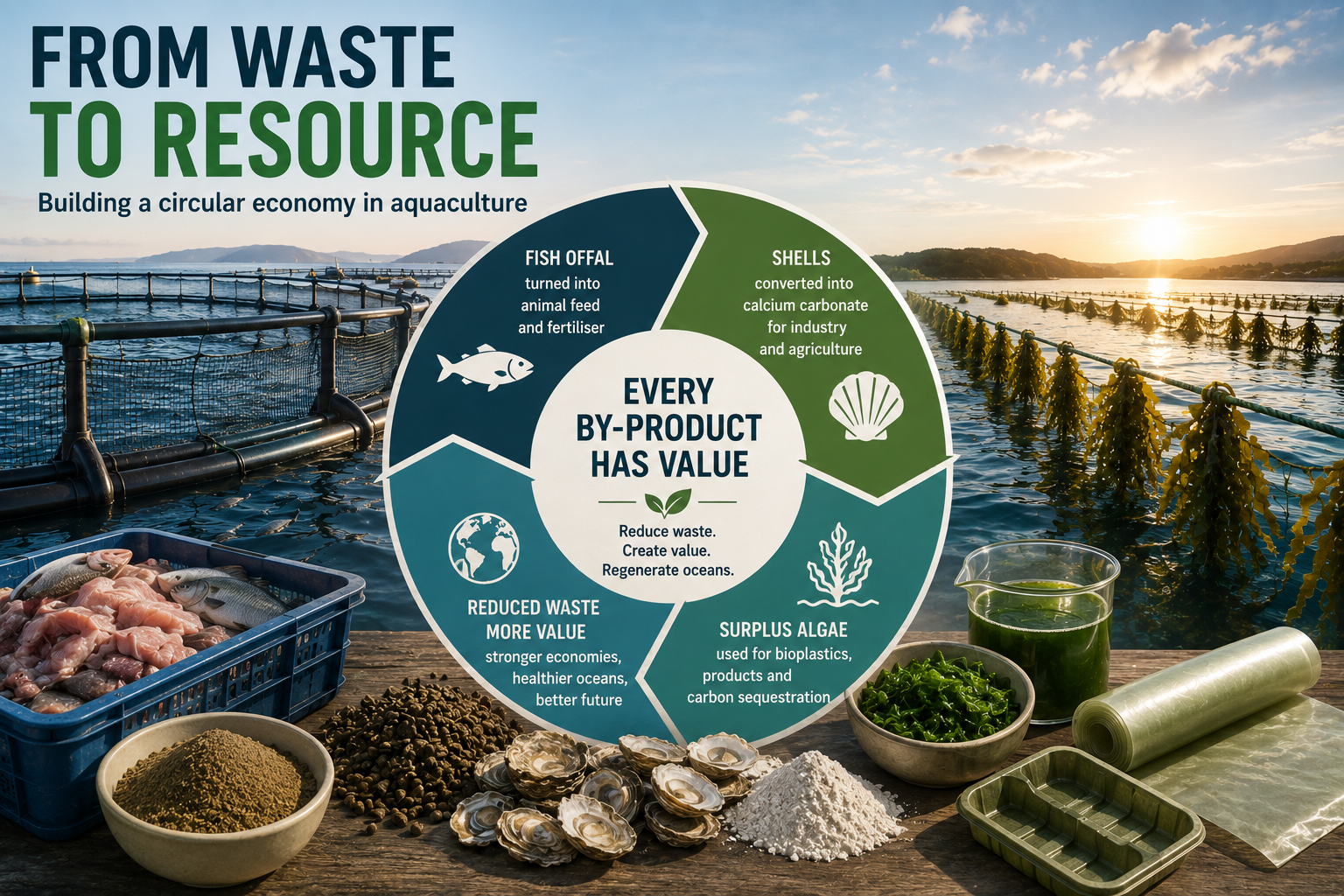
The appeal of IMTA lies in its potential to transform waste from an environmental liability into a productive resource. Instead of treating nutrient outputs solely as pollutants requiring management, integrated systems attempt to capture and recycle them within the production process itself.
Research suggests that such systems may improve nutrient utilisation and reduce environmental impacts when appropriately designed and managed.^6 While outcomes vary considerably according to local ecological conditions, IMTA represents one of the clearest attempts to align aquaculture with ecological principles rather than simply mitigating its negative consequences.
Shellfish and Seaweed as Regenerative Species
Among the most frequently cited examples of regenerative aquaculture are shellfish and seaweed cultivation.
Unlike carnivorous finfish species, bivalves such as oysters and mussels generally require no external feed inputs. They obtain nutrition by filtering naturally occurring particles from the water column. Through this process, shellfish cultivation may contribute to improvements in water clarity and nutrient cycling under suitable environmental conditions.^7
Seaweeds offer a similarly intriguing possibility. By absorbing dissolved nutrients such as nitrogen and phosphorus, seaweed cultivation may help mitigate nutrient enrichment in some coastal environments while simultaneously producing food, feed, fertilisers, and industrial raw materials.^8
It would be misleading, however, to portray shellfish or seaweed cultivation as universal solutions. Their ecological benefits depend upon location, scale, and management. Nonetheless, these systems demonstrate that food production and ecosystem services need not always exist in opposition.
The Economic Challenge
The ecological case for regenerative aquaculture is only part of the equation. Production systems must also remain economically viable if they are to be adopted at scale.
This challenge is particularly apparent in the case of Integrated Multi-Trophic Aquaculture. Although the environmental rationale for nutrient recycling is well established, researchers have noted that economic incentives often lag behind ecological benefits.^9 Producers may receive compensation for marketable products such as fish, shellfish, or seaweed, while ecosystem services such as nutrient removal or water quality improvements frequently remain uncompensated.
This reflects a broader problem within environmental economics. Markets tend to reward private outputs more effectively than public ecological benefits. Consequently, regenerative systems may generate substantial social value while struggling to achieve comparable financial returns.
Without mechanisms that recognise and reward ecosystem services, the widespread adoption of regenerative aquaculture may remain constrained.
Governance and Institutional Design
As Raymond Rogers argued in The Oceans Are Emptying: Fish Wars and Sustainability, environmental outcomes are often shaped less by ecological limits than by the political and economic structures through which resources are managed.^10 The same observation applies to aquaculture.
Technological innovation alone cannot guarantee sustainability. Effective governance, transparent regulation, scientific monitoring, and stakeholder participation all influence environmental performance. The FAO’s Ecosystem Approach to Aquaculture emphasises that aquaculture development should be integrated within broader ecological and social systems rather than managed in isolation.^11
Consequently, regenerative aquaculture should be understood not merely as a technological innovation but as an institutional challenge. Success depends upon aligning economic incentives with ecological objectives.
Conclusion
Can aquaculture be regenerative?
The evidence suggests that under specific conditions it can. However, regeneration should be treated as an outcome rather than a marketing label.
Aquaculture becomes regenerative when it enhances ecological functions rather than merely reducing environmental harm. Systems that recycle nutrients, incorporate complementary species, provide ecosystem services, and operate within effective governance frameworks offer the strongest examples of this approach.
The future of aquaculture is therefore unlikely to be determined by a single technology or production model. Instead, it will depend upon whether producers, researchers, and policymakers can design systems that work with ecological processes rather than against them.
The question is not whether aquaculture can replace nature. It cannot. The more meaningful question is whether aquaculture can learn from nature’s capacity for circulation, resilience, and renewal. In some places, that process has already begun.

Footnotes
- Food and Agriculture Organization, The State of World Fisheries and Aquaculture 2024 (Rome: FAO, 2024); see also reporting on the FAO findings.
- Rosamond L. Naylor et al., ‘Effect of Aquaculture on World Fish Supplies’, Nature, 405 (2000), pp. 1017–1024.
- Naylor et al., pp. 1017–1024.
- Naylor et al., pp. 1017–1024.
- FAO, Integrated Mariculture: A Global Review (Rome: FAO).
- Thierry Chopin et al., foundational IMTA literature.
- FAO, shellfish aquaculture guidance documents.
- FAO, seaweed aquaculture reports.
- D. Knowler et al., ‘The Economics of Integrated Multi-Trophic Aquaculture’, Reviews in Aquaculture (2020).
- Raymond A. Rogers, The Oceans Are Emptying: Fish Wars and Sustainability (Montréal: Black Rose Books, 1995).
- FAO, Aquaculture Development No. 4: Ecosystem Approach to Aquaculture (Rome: FAO, 2010).
Bibliography
- FAO. Aquaculture Development No. 4: Ecosystem Approach to Aquaculture. Rome: Food and Agriculture Organization, 2010.
- FAO. The State of World Fisheries and Aquaculture 2024. Rome: Food and Agriculture Organization, 2024.
- Knowler, D. et al. ‘The Economics of Integrated Multi-Trophic Aquaculture’. Reviews in Aquaculture (2020).
- Naylor, R. L., Goldburg, R. J., Primavera, J., et al. ‘Effect of Aquaculture on World Fish Supplies’. Nature, 405 (2000), pp. 1017–1024.
- Rogers, R. A. The Oceans Are Emptying: Fish Wars and Sustainability. Montréal: Black Rose Books, 1995.
-

2026/09/11
The Bio-Circular Economy and Sustainable Aquaculture The bio-circular economy provides a framework for addressing the…
-

2026/09/11
The UK Aquaculture Market: Diversity, Scale and Concentration The United Kingdom has a significant aquaculture…
-
2026/08/11
From Waste to Resource: The Circular Economy of Aquaculture By-Products One of the fundamental principles…
