
The UK Aquaculture Market: Diversity, Scale and Concentration
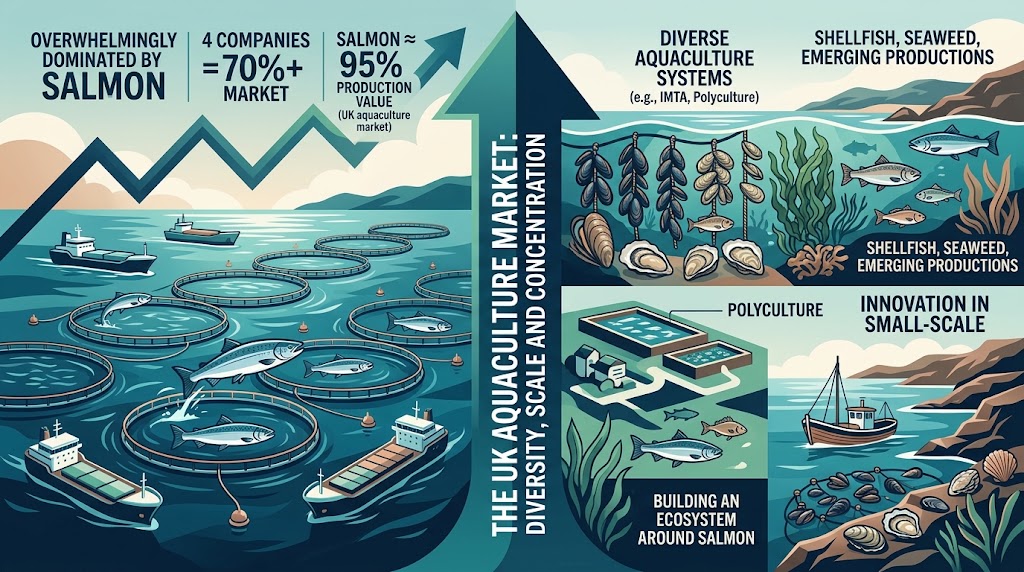
The United Kingdom has a significant aquaculture industry, but the sector is far less diverse than its overall size might suggest. Although aquaculture encompasses finfish, shellfish, seaweed and a range of emerging production systems, the UK market remains overwhelmingly dominated by Atlantic salmon farming.
The scale of this concentration is striking. Mowi Scotland Ltd, Scottish Sea Farms Ltd, Cooke Aquaculture Scotland Ltd and Bakkafrost Scotland Ltd account for more than 70 per cent of the UK aquaculture market, according to industry estimates cited by the British Veterinary Association. Salmon alone accounts for approximately 95 per cent of aquaculture production by value and around 90 per cent by volume.^1
This creates an unusual market structure. The UK possesses extensive marine resources and considerable potential for developing a more diverse aquaculture industry, yet a relatively small number of large producers dominate the commercial sector. The result is an industry in which the economic success of aquaculture is closely tied to the performance of a single species and production model.
The advantage of scale
Large-scale salmon farming has several advantages. Capital-intensive infrastructure, specialised knowledge, established supply chains and access to international markets all favour companies capable of operating at significant scale. The concentration of production can therefore be understood partly as an economic consequence of the industry’s development rather than simply as a failure of competition.
The wider UK economy also tends to favour industries that can compete through high-value, differentiated products rather than through low-cost commodity production. Research from the Institute for Manufacturing at the University of Cambridge highlights the importance of higher-value economic activity within the UK’s industrial structure.^2 For aquaculture, this presents both a constraint and an opportunity.
Britain is unlikely to become a global leader in aquaculture by competing solely on the basis of producing large quantities of inexpensive seafood. The more promising route may instead involve developing products capable of commanding higher prices through quality, provenance, processing, branding and environmental differentiation.
Where do smaller producers fit?
The remaining portion of the market is considerably more fragmented. Smaller producers operate across shellfish, finfish and emerging forms of marine farming, and some are experimenting with alternative production models including integrated multi-trophic aquaculture (IMTA) and polyculture.
These systems are potentially important because they challenge the assumption that aquaculture must be based around a single species and a single product. IMTA, for example, deliberately combines organisms occupying different trophic levels so that the outputs of one component can become inputs for another. This can improve resource utilisation while creating additional products and revenue streams.^3
Small-scale aquaculture can also provide opportunities for innovation that are difficult to achieve within highly standardised commodity production. Research into small-scale aquaculture has demonstrated the importance of innovation and differentiation in enabling producers to compete in challenging markets.^4
The problem is that innovation alone is not enough.
Smaller producers frequently lack the infrastructure and market access available to major producers. Processing, cold storage, logistics, distribution and reliable buyers can all become significant barriers when production volumes are relatively small. A farm may be capable of producing a novel and environmentally attractive product, but that does not necessarily mean there is a functioning market capable of purchasing it at a profitable price.
This creates something of a paradox. The technologies and production methods required to diversify British aquaculture already exist, but the surrounding economic infrastructure has not necessarily developed alongside them.
The missing middle
The future of UK aquaculture may therefore depend less on simply increasing production and more on developing what could be described as a missing middle between small producers and large industrial farms.
A diversified aquaculture sector requires more than farmers. It requires hatcheries, feed suppliers, processing facilities, transport infrastructure, wholesalers, retailers, certification systems, research institutions and customers willing to pay for differentiated products.
This is particularly important for species and products that cannot compete directly with internationally produced commodities on price. Shellfish, seaweed and integrated farming systems may need to create value through local supply chains, processing, branding and specialised applications rather than attempting to compete solely as bulk commodities.
The same principle applies to sustainability. Environmental credentials can become an economic advantage only when they are connected to a market willing to recognise and pay for them. Otherwise, sustainability becomes an additional production cost rather than a source of competitive advantage.
A more diverse future
The dominance of salmon does not necessarily mean that the UK aquaculture industry is incapable of diversification. Instead, it demonstrates the economic difficulty of building alternative industries alongside an established and highly capitalised sector.
The opportunity lies in identifying markets where smaller producers can compete through differentiation rather than scale.
Seaweed products, premium shellfish, regenerative aquaculture, IMTA, locally processed seafood and novel marine biomaterials could all occupy such niches. The challenge is to develop the supply chains around them so that these activities become commercially viable rather than remaining isolated experiments.
The UK’s geographical position gives it considerable marine potential. What it lacks is not necessarily the capacity to produce more from the sea, but the economic infrastructure required to turn that potential into a diverse and profitable industry.
For Circular Stream, this distinction is important. A sustainable aquaculture sector cannot be judged solely by how much it produces. It should also be judged by what it produces, who captures the value, how that value moves through the economy, and whether the system creates opportunities for new producers to enter the market.
The future of British aquaculture may therefore not be about replacing large-scale salmon farming. It may be about building an ecosystem around it in which a much wider range of marine enterprises can develop alongside it.
Citation List
- British Veterinary Association, BVA Policy Position on Sustainable Fin-Fish Aquaculture (British Veterinary Association, 2023).
- Institute for Manufacturing, University of Cambridge, ‘Structure of the UK Economy’, Cambridge Industrial Innovation Policy (2023).
- T. Chopin, J. A. Cooper, G. Reid, S. Cross and C. Moore, ‘Integrated Multi-Trophic Aquaculture. What It Is, and Why You Should Care… and Don’t Confuse It with Polyculture’, North American Journal of Aquaculture, 70.2 (2008), pp. 139–158.
- C. Salazar, M. Jaime, Y. Figueroa and R. Fuentes, ‘Innovation in Small-Scale Aquaculture in Chile’, Aquaculture Economics & Management, 22.2 (2018), pp. 151–167.
Bibliography
British Veterinary Association, BVA Policy Position on Sustainable Fin-Fish Aquaculture (London: British Veterinary Association, 2023).
Chopin, T., Cooper, J. A., Reid, G., Cross, S. and Moore, C., ‘Integrated Multi-Trophic Aquaculture. What It Is, and Why You Should Care… and Don’t Confuse It with Polyculture’, North American Journal of Aquaculture, 70.2 (2008), pp. 139–158.
Institute for Manufacturing, University of Cambridge, ‘Structure of the UK Economy’, Cambridge Industrial Innovation Policy (2023).
Salazar, C., Jaime, M., Figueroa, Y. and Fuentes, R., ‘Innovation in Small-Scale Aquaculture in Chile’, Aquaculture Economics & Management, 22.2 (2018), pp. 151–167.