
The Bio-Circular Economy and Sustainable Aquaculture
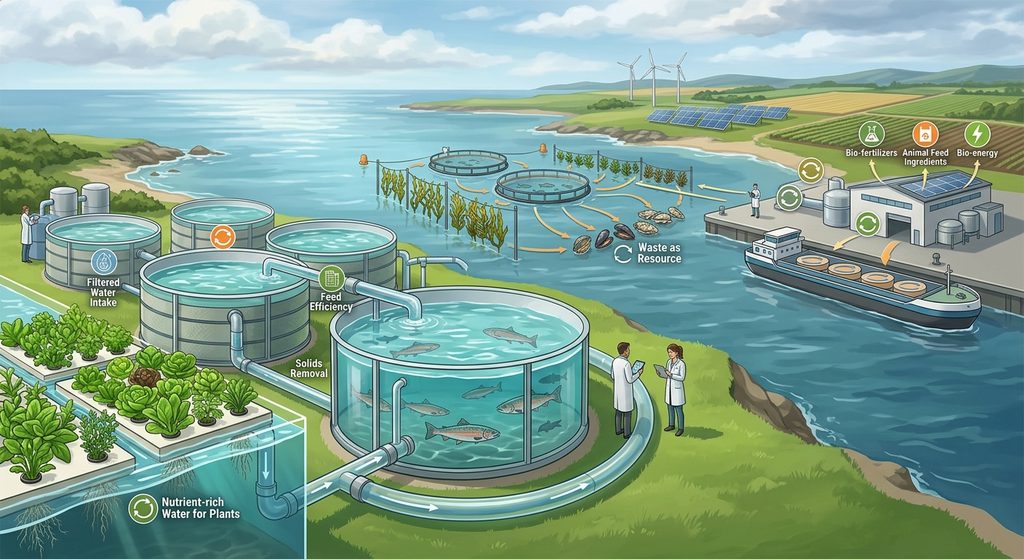
The bio-circular economy provides a framework for addressing the environmental and economic inefficiencies associated with conventional aquaculture. Rather than treating waste as an unavoidable consequence of production, circular approaches seek to retain materials, nutrients, energy and biological resources within productive systems for as long as possible. In aquaculture, this can involve changes to feed production, water management, waste treatment, processing and the utilisation of biological by-products.
The concept therefore extends beyond simply reducing the environmental impacts of fish farming. It proposes a different approach to production in which materials are continually recovered, reused and redirected towards new applications. This has the potential to reduce resource consumption while creating additional economic value from materials that would otherwise be discarded.
From linear production to circular systems
Conventional aquaculture can operate according to a relatively linear model. Inputs such as feed, water and energy enter the production system, fish and other products are harvested, and nutrients and other materials leave the system as waste.
The circular economy seeks to disrupt this linear process by maintaining materials and products within productive cycles. This includes reducing waste at source, extending the useful life of products and recovering materials at the end of their initial use.^1
For aquaculture, the biological nature of production creates particular opportunities for this approach. Waste streams are often composed of organic materials and nutrients that can potentially be incorporated into other production systems. Fish waste, for example, can be processed into fertilisers or other value-added products, while nutrients released during production can potentially support the cultivation of other organisms.^2
This changes the role of waste within the production system. Rather than being regarded exclusively as an environmental liability, it can become a potential input into another economic activity.
Feed and resource efficiency
Feed represents one of the most significant material inputs in aquaculture, making the development of sustainable feed systems an important component of circular production.
Traditional aquafeeds have relied substantially upon ingredients such as fishmeal and fish oil, although considerable research has focused on replacing these inputs with alternative ingredients. Plant-based materials, algae, microbial products and other novel feed ingredients may reduce pressure on wild fisheries and create opportunities to incorporate additional waste or by-products into feed production.^3
The circular economy therefore encourages a broader consideration of feed efficiency. The objective is not simply to increase the quantity of fish produced from a given quantity of feed, but to consider where feed ingredients originate, how efficiently they are converted into biomass and what happens to the materials that remain within the system.
This is particularly relevant as aquaculture continues to expand. Increasing production without addressing the resource requirements of feed risks transferring environmental pressures elsewhere in the food system.
Recycling nutrients through integrated production
The management of nutrients provides another major opportunity for circular aquaculture.
Fish excretion and uneaten feed can release nitrogen, phosphorus and organic matter into the surrounding environment. When these materials accumulate beyond the assimilative capacity of an ecosystem, they can contribute to pollution and ecological degradation.^4
Integrated production systems attempt to address this problem by connecting organisms with complementary ecological functions.
Aquaponics, for example, combines aquatic animal production with plant cultivation, allowing nutrients generated by the aquatic component to contribute to plant growth. Integrated multi-trophic aquaculture (IMTA) applies a related principle within aquatic environments by combining species occupying different trophic positions. Nutrients and organic materials generated by one component can consequently become resources for another.^5
The significance of these systems is not that they eliminate waste entirely. Rather, they demonstrate how the outputs of one production process can become inputs into another.
This represents a fundamental shift in how aquaculture can be designed: instead of attempting to isolate production from its waste streams, production systems can be structured around the movement and utilisation of those materials.
Recirculating water systems
Water represents another important resource within aquaculture.
Conventional systems may require substantial water exchange, resulting in the movement of nutrients and other materials out of the production system. Recirculating aquaculture systems (RAS) seek to reduce this requirement by treating and reusing water within the production process.^6
RAS technologies can substantially reduce water consumption and the discharge of pollutants, although they also introduce additional infrastructure and energy requirements. Their environmental performance therefore depends upon the wider design of the system, including the source of energy used to operate it.
This illustrates an important limitation of circular-economy thinking. Closing one resource loop does not necessarily eliminate environmental impacts elsewhere. A system that substantially reduces water consumption but requires large quantities of energy may simply shift part of its environmental burden from one resource to another.
Circularity should therefore be assessed across the entire production system rather than through individual technologies in isolation.
Creating value from aquaculture by-products
The potential for circularity extends beyond the farm itself.
Aquaculture and seafood processing generate a range of biological by-products, including shells, bones, skins and other tissues. Historically, some of these materials have been treated primarily as waste. However, research into the circular bioeconomy has identified opportunities to convert biological residues into fertilisers, bioenergy, pharmaceuticals, food ingredients and other value-added products.^7
The economic significance of this approach is considerable.
If a material has no further use, its disposal represents a cost. If that same material can be transformed into a commercially valuable product, it becomes a potential source of revenue.
This creates the possibility of multiple value streams from a single production system.
Such an approach is particularly relevant to smaller producers. A farm that cannot compete with industrial producers on production volume may nevertheless be able to generate additional value by processing and differentiating its outputs. However, achieving this requires access to appropriate processing facilities and markets.
The importance of supply chains
The transition towards a bio-circular economy therefore cannot be achieved solely at the farm level.
Circular systems depend upon connections between producers, processors, distributors and consumers. If a producer generates a potentially valuable biological by-product but there is no economically viable method of collecting, processing or transporting it, that material will remain waste in practice.
This means that circularity requires changes to supply-chain structures as well as production technologies. Materials must be capable of moving between businesses, while organisations need to develop relationships that allow one industry’s outputs to become another industry’s inputs.^8
Water provides a useful example. A wastewater stream may be considered a disposal problem by one business but a potential source of nutrients by another. The economic value of the resource therefore depends partly upon whether the two systems are connected.
The same principle applies to aquaculture by-products, organic waste and other biological materials.
The barriers to circular aquaculture
Despite its potential, the transition towards a bio-circular economy is not straightforward.
New production systems require investment in infrastructure, technology and training. Businesses must also develop new forms of technical knowledge and establish markets for products that may be unfamiliar to consumers.^9
There are also institutional and behavioural barriers. Existing supply chains are generally designed around established production methods, while businesses have developed relationships and processes that can be difficult to change. Circular systems may therefore require cooperation between stakeholders who have traditionally operated independently.^10
Market demand presents another challenge. A technically viable circular product does not necessarily constitute a commercially viable one. Consumers must be willing to purchase it, and its price must be sufficient to justify the additional processing required.
This is particularly important for products derived from materials traditionally regarded as waste. Changing the perception of these materials may be as important as developing the technology required to process them.
The economics of circularity
The economic case for circular aquaculture consequently depends upon more than simply reducing waste.
Circular systems can reduce expenditure on certain inputs, reduce disposal requirements and create additional revenue streams from by-products. However, these benefits must be weighed against the capital and operating costs associated with recovery, processing and reuse.
The most economically effective systems may therefore be those capable of connecting several forms of production.
An aquaculture farm could potentially supply nutrients to agricultural production. Processing waste could become an input for fertiliser production. Shells could be processed into new materials. Organic residues could contribute to energy generation.
In such systems, the value of the farm is no longer determined exclusively by the primary product it sells.
Instead, value can be created across a network of interconnected activities.
Towards a circular aquaculture industry
The bio-circular economy provides an alternative way of thinking about the development of aquaculture.
The objective is not simply to produce more seafood while reducing the environmental damage associated with production. It is to redesign production so that fewer resources are lost from the system and a greater proportion of its outputs can be put to productive use.
This approach has implications at several levels.
At the farm level, it encourages more efficient use of feed, water and energy. At the production-system level, it supports technologies such as RAS, aquaponics and IMTA. At the industrial level, it creates opportunities to develop new products from biological by-products. At the economic level, it encourages the development of supply chains in which the outputs of one industry become inputs for another.
The transition will nevertheless require investment, infrastructure and changes in market behaviour. Circularity cannot simply be imposed upon an existing linear economy; the relationships that allow resources to circulate must themselves be developed.
For aquaculture, this may ultimately represent one of the industry’s greatest opportunities.
The question is no longer simply how to reduce the amount of waste generated by fish farming.
It is whether aquaculture can be incorporated into a broader system in which waste, nutrients, water and biological materials are continually redirected towards productive uses.
A genuinely circular aquaculture industry would therefore not be defined solely by how efficiently it produces fish. It would also be defined by how effectively it connects that production to the wider economy.
The long-term objective is not a system in which nothing is discarded.
It is a system in which resources remain valuable for longer, and where the boundary between waste and raw material becomes increasingly difficult to distinguish.
References and Citations
- Behera (2023) discusses the principles of the circular economy and the retention and reuse of materials and resources within productive systems.
- Fraga-Corral et al. (2022) examine opportunities for waste valorisation and the development of a circular bioeconomy within aquaculture.
- Research within the user’s dissertation reference base includes Macusi et al. (2023), Malcorps et al. (2019), Masagounder et al. (2016), Shahin et al. (2023) and Zlaugotne et al. (2022) on alternative and sustainable aquafeed ingredients.
- Verdegem (2013) examines nutrient discharge from aquaculture and the environmental consequences of nutrient losses.
- Chopin et al. (2008) establish the principles of integrated multi-trophic aquaculture and the use of complementary species within integrated production systems.
- Espinal and Matulić (2019) examine recirculating aquaculture technologies and their potential to reduce water requirements and environmental discharges.
- Fraga-Corral et al. (2022) discuss the valorisation of aquaculture by-products within the circular bioeconomy.
- Montag (2022) examines the development of circular supply chains and the structural changes required to facilitate resource circulation between businesses.
- Chembessi (2023) examines knowledge and implementation challenges associated with the circular economy, while Bhatt et al. (2017) examine opportunities for converting food waste into value-added products.
- Morseletto et al. (2022) examine the challenges involved in developing circular systems and changing established resource-use patterns.
Bibliography
Behera, [first name], ‘Circular Economy and Waste’ (2023).
Bhatt, S. et al., ‘Food Waste and Value-Added Products’ (2017).
Chembessi, [first name], ‘Circular Economy Knowledge’ (2023).
Chopin, T., Cooper, J. A., Reid, G., Cross, S. and Moore, C., ‘Integrated Multi-Trophic Aquaculture. What It Is, and Why You Should Care… and Don’t Confuse It with Polyculture’, North American Journal of Aquaculture, 70.2 (2008), pp. 139–158.
Espinal, C. A. and Matulić, D., ‘Recirculating Aquaculture Technologies’ (2019).
Fraga-Corral, M. et al., ‘Aquaculture and the Circular Bioeconomy’ (2022).
Macusi, E. D. et al., ‘Fishmeal Replacement and Alternative Aquafeed Ingredients’ (2023).
Malcorps, W. et al., ‘Fishmeal Substitution in Aquafeeds’ (2019).
Masagounder, K. et al., ‘Alternative Ingredients for Aquafeeds’ (2016).
Montag, L., ‘Circular Supply Chains’ (2022).
Morseletto, P. et al., ‘Circular Economy of Water’ (2022).
Shahin, S. et al., ‘Alternative Feed Ingredients’ (2023).
Verdegem, M. C. J., ‘Nutrient Discharge from Aquaculture Systems’ (2013).
Zlaugotne, B. et al., ‘Sustainable Feed Ingredients’ (2022).